Río Negro was the heartland of Patagonian wine production and this fertile river valley has been planted wine vines for over 100 years. Although Río Negro is still the second largest wine region in southern Argentina (just pipped to the post by Neuquen), it is, unfortunately, one in decline – its old vines being regularly abandoned due to the diminishing infrastructure and labour force in the Río Negro wine region.
In the heydey of Río Negro, in the early 20th century, it was the third most important wine region in Argentina with over 300 wineries and some 18,000 hectares of vines. There was during this time a great diversity of grape varieties including more obscure varieties including Trousseau, Refosco, Semillon and Riesling.
It is the existence of these old vines which is alluring wine producers to refocus their energies and attention on this ebbing wine region. The rediscovery of some of the low yielding old vines, of well-known varieties (such as Pinot Noir and Malbec) and lesser-known varieties, is producing some of the most exciting wines in Argentina today.
The wines of Río Negro are known for their balance and elegance, partly due to the older age of vines in the wine region but also due to the low altitude and greater latitude which gives slightly milder temperatures than in the Cuyo region with great luminosity, thermal amplitude and slower maturation. The Río Negro wine region is capable of producing a wide range of grape varieties: from fresh Riesling and Pinot Noir wines to nuanced Malbec and Cabernet Sauvignon.
The Río Negro wine region may still have its challenges, and the number of producers is still dwindling, but Río Negro is certainly one to watch. Although quantity is dropping, the quality of wines from Río Negro has never been better.
Fact file on Río Negro wine region
- First planted: Late 1800s
- Hectares planted: 1617.5
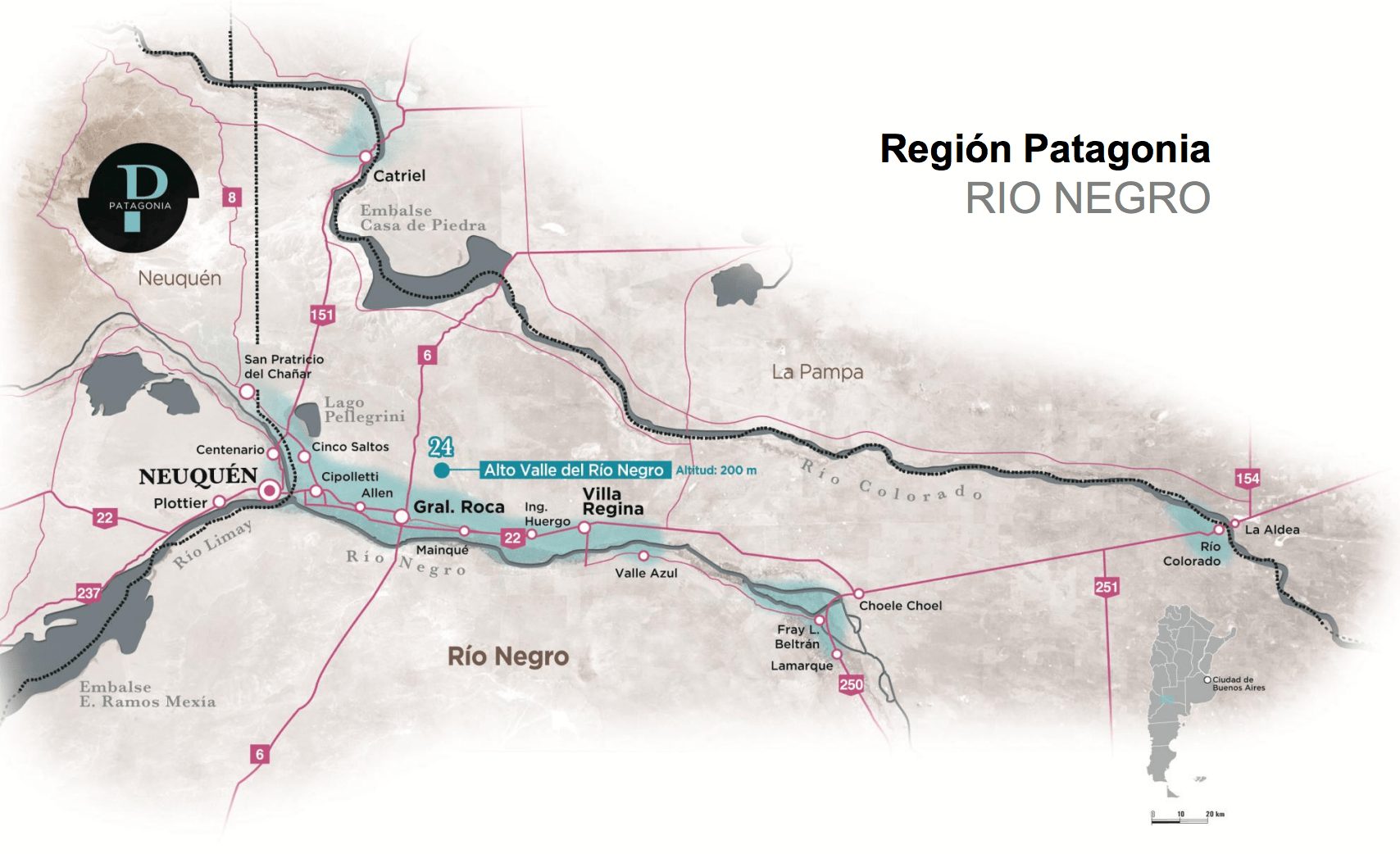
- No wineries/vineyards: 24
- Average vineyard size & production size: Medium-sized wineries and vineyards
- Regions & sub-regions: Río Colorado Upper Valley, Río Negro Upper Valley, Río Negro Middle Valley, Río Colorado Lower Valley, Río Negro Lower Valley
- Latitude: 39.03°S
- Longitude: 67.59°W
- Altitude: 4 to 370 metres.
- Geological description: Most of the vineyards are planted on the banks of Río Negro, either in the Upper Valley (where the majority of vineyards are) or the Lower Valley heading towards the coast.
- Soil formation & characteristics: The Upper Valley (where the majority of vineyards are) is poor in organic matter with mixed clay and sandy loam soils with gravel (between 5 to 30%) on the surface.
- Climate type and info: A dry and mild continental climate.
- Winkler/Heat: III to IV
- Avg. growing season day time: 29°C
- Avg. growing season night time: 11°C
- Diurnal range: 18°C
- Rainfall average (and when): 190mm per year. Concentrated in March, September & October but rains all year.
- Adverse climate conditions: Frost & wind
- Most planted varieties: Malbec, Merlot, Pinot Noir, Cabernet Sauvignon, Pedro Jiminez
- Avg. vine age: 30-100 years old
- Vineyard management: 72% VSP, 22% Parral, 6% Others
Useful resources on Río Negro: Wines of Argentina, INV, 80 Harvests, South American wine production in numbers.
Video guides to Río Negro wine region & wines
Winemaker Marcelo Miras discusses Río Negro terroir and history
Marcelo Miras is one of the most experienced winemakers in Río Negro and nearby Neuquen, having worked for Bodega del Fin del Mundo and his own eponymously named winery, Bodega Miras. In this video interview (in Spanish with subtitles) Marcelo discusses the terroir of Río Negro wine region and shares his insights into the challenges and benefits of vine growing in Patagonia.
Winemaker Piero Incisa della Rocchetta discusses Pinot Noir in Río Negro
Piero Incisa della Rocchetta comes from a renowned wine dynasty in Italy but chose to start his own boutique winery in Río Negro. Amanda Barnes interviews him on why he chose to make Pinot Noir in Río Negro with Bodega Chacra, when ultimately he could have made it anywhere in the world. They talk old vines and a countryside lifestyle in a biodynamic vineyard.
The potential of Río Negro and old vines with Hans Vinding Diers
Hans Vinding Diers has made wine all over the world but the old vines of Río Negro attracted him to start making wine here. Noemia winery is one of Argentina’s most prized and the complex red wines are a testimony to the great potential in Río Negro. In this video interview, Amanda Barnes asks Hans about the climate, soil and old vines of Río Negro wine region.
Wineries in Río Negro
Humberto Canale: A historic winery and vineyard established in 1909. The largest producer in Río Negro with some very old vines.
Bodega Noemia: Hans Vinding Diers’ winery which has some magnificent old vines and rich red wines.
Bodega Chacra: A biodynamic winery specialising in Pinot Noir owned by the renowned Italian winemaker Piero Incisa della Rocchetta.
Bodega Miras: A family-run winery with old vines of Semillon and Trousseau in Río Negro.
Matias Riccitelli: Although not based in Río Negro, this Mendocinean winemaker has some excellent Río Negro wines in his portfolio including old vine Semillon.
Río Negro travel highlights
Río Negro wine region is situated around the riverbanks in the northern part of the province, where visiting wineries is the best travel highlight. You can also venture to nearby Neuquén where you can visit dinosaur museums and fossils.
Within the larger province of Río Negro, the Andes to the west offer excellent mountain hikes and lake views around the main city of Bariloche. The coast to the east is also a popular tourism destination for its beaches and whale watching.
Río Negro wine guide: related articles
Semillon in Argentina & Chile: An old vine revolution
Río Negro wines to try
Analysis of top rated and best wines in South America on Vivino
